

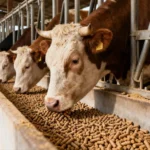


Producing floating fish feed requires more than simply purchasing an extrusion machine. The raw material preparation process, formulation, extrusion conditions, drying, cooling, screening, and packaging all influence the quality and production efficiency of the final product. For aquaculture farms and commercial feed manufacturers, choosing equipment according to actual production requirements can help avoid unnecessary investment and production bottlenecks.
The floating fish feed extruder machine for sale market includes equipment with different capacities, screw configurations, motor powers, feeding systems, and automation levels. Therefore, buyers should evaluate the complete production process instead of comparing machines only by price or motor power.
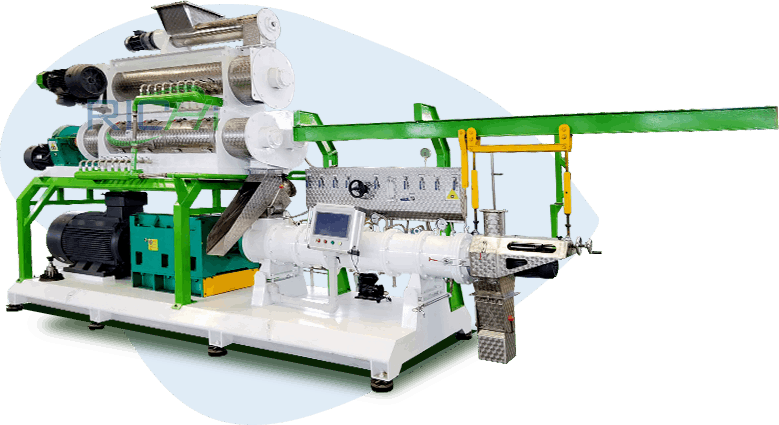
Why Is Extrusion Important for Floating Fish Feed?
Extrusion is one of the key processes used to manufacture floating fish feed.
During extrusion, the prepared feed mixture is conveyed and compressed inside the extrusion chamber. Under the combined effects of pressure, heat, moisture, and mechanical shear, the material becomes plasticized before passing through the die.
When the material exits the die, the sudden pressure reduction causes moisture to expand into steam. This creates a porous structure inside the extruded material, reducing its density and allowing the pellets to float.
The floating time depends on the formulation and extrusion conditions. Therefore, the extruder must be configured according to the specific feed formula rather than using one standard setting for every product.
What Raw Materials Are Suitable?
Floating fish feed can contain a combination of cereal ingredients, plant proteins, animal proteins, oils, minerals, vitamins, and functional additives.
Common ingredients include corn, wheat, soybean meal, fish meal, rice bran, wheat bran, protein concentrates, and other locally available materials.
The formula can vary according to fish species and growth stage.
For example, juvenile fish may require smaller pellets and a different nutritional profile from larger fish.
The raw material characteristics also influence extrusion. Starch content is particularly important because it contributes to expansion during extrusion.
Protein, fiber, fat, and moisture levels can also affect pellet density and water stability.
Why Is Raw Material Grinding Necessary?
Before extrusion, most ingredients need to be ground into a suitable particle size.
A hammer mill can reduce larger materials and improve particle uniformity.
Consistent particle size helps the mixer distribute ingredients more evenly and can improve the stability of extrusion.
For small-diameter fish feed, particle size becomes even more important.
If large particles remain in the mixture, they may interfere with die discharge and result in inconsistent pellet appearance.
However, grinding materials excessively fine can increase electricity consumption.
The appropriate grinding specification should therefore be determined according to the target pellet diameter and formula.
How Does Mixing Affect Extrusion?
After grinding, different ingredients are weighed and mixed according to the formula.
A uniform mixture is essential because floating fish feed may contain small quantities of vitamins, minerals, additives, or other functional ingredients.
If the mixture is not homogeneous, nutritional distribution between pellets can vary.
The mixer should also have sufficient capacity to supply the extrusion section continuously.
For commercial plants, automatic batching and weighing can improve formula accuracy and reduce manual handling.
A well-designed material preparation section creates a more stable feed stream for the extruder.
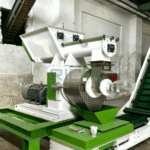
How Does a Floating Feed Extruder Work?
The prepared mixture enters the extruder through a controlled feeding system.
Inside the machine, the screws transport the material forward while simultaneously compressing and shearing it.
Depending on the machine configuration, water and steam may be introduced to control moisture and temperature.
The material gradually becomes plasticized under the combined action of heat, pressure, and mechanical energy.
When it reaches the die, the compressed material is forced through the openings.
After leaving the die, the pressure drops rapidly and the water vapor expands.
This expansion creates the porous structure required for floating pellets.
A cutting device then divides the extruded material into pellets of the desired length.
What Determines Whether Pellets Float?
Floating performance is influenced by several factors rather than one machine setting.
Formula composition is important because starch contributes significantly to expansion.
Moisture also affects extrusion behavior.
Screw speed, feed rate, temperature, pressure, and die configuration can influence the final pellet density.
If the product is too dense, it may sink quickly. If expansion is excessive, the pellet may have insufficient physical strength.
Therefore, the objective is not simply maximum expansion.
The production process should achieve an appropriate balance between floating ability, water stability, hardness, and nutritional requirements.
What Pellet Sizes Can Be Produced?
Different fish species require different pellet sizes.
Very small fish may require fine pellets, while larger fish can consume larger particles.
The die opening primarily determines pellet diameter.
The cutter controls pellet length by adjusting its operating speed and position.
A factory producing several pellet sizes may need multiple dies and corresponding operating parameters.
Changing pellet specifications can also influence production capacity.
For this reason, buyers should tell the equipment manufacturer the target pellet size range before purchasing the machine.
What Capacity Should Buyers Choose?
Capacity should be calculated according to actual feed demand.
A small aquaculture farm may only require several hundred kilograms per hour.
A commercial feed manufacturer supplying multiple farms may require one or several tons per hour.
However, the theoretical capacity of an extruder should not be treated as guaranteed output under every formula.
High-protein, high-fat, or high-fiber formulations can behave differently from conventional grain-based formulas.
Moisture and pellet size can also affect production.
A realistic capacity assessment should therefore consider the actual formula and operating conditions.
Is a 1 Ton Per Hour Machine Suitable?
A 1 ton per hour production system can be suitable for smaller commercial operations or medium-sized aquaculture farms.
If the factory operates eight hours per day, the theoretical production can reach approximately 8 tons per day before accounting for startup, cleaning, maintenance, formula changes, and other downtime.
This may be sufficient for a farm producing feed primarily for its own fish ponds.
For a manufacturer selling feed commercially, additional capacity may be required depending on market demand.
The important point is to calculate daily production rather than selecting equipment based only on the largest possible hourly output.
What Equipment Is Needed Besides the Extruder?
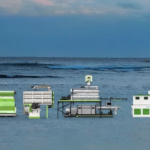
A complete floating fish feed production line normally includes several processing stages.
A typical configuration may include:
- Raw material receiving and cleaning
- Grinding
- Batching and weighing
- Mixing
- Conditioning or moisture adjustment
- Extrusion
- Cutting
- Drying
- Cooling
- Screening
- Oil or coating application
- Packaging
Not every project requires exactly the same equipment.
A small farm may use a relatively simple setup, while a commercial factory may require automatic batching, multiple storage bins, continuous drying, coating equipment, and automated packaging.
The final configuration should match the required production capacity.
Why Is Drying Necessary?
Freshly extruded floating pellets normally contain considerable moisture.
Before storage, this moisture needs to be reduced to an appropriate level.
A continuous dryer can remove excess moisture while maintaining a stable production flow.
The dryer should be selected according to the output of the extruder.
If extrusion capacity is significantly higher than drying capacity, pellets can accumulate and interrupt production.
For larger factories, multi-layer or multi-pass drying systems may be used to increase drying efficiency while controlling product quality.
What Happens During Cooling?
After drying, the pellets remain warm.
Cooling reduces their temperature before they enter screening, coating, storage, or packaging.
Proper cooling also helps stabilize the product after drying.
The cooling system should have sufficient capacity to handle the expected production volume.
A balanced line ensures that the extrusion, drying, cooling, and screening sections can operate continuously without creating bottlenecks.
Is Oil Coating Required?
Some floating fish feed formulas require additional oil or liquid nutritional ingredients after extrusion.
A coating system can apply oil or other liquid ingredients to the surface of cooled pellets.
This process can improve energy density and allow certain heat-sensitive ingredients to be added after extrusion.
The coating method depends on the formula and product requirements.
Not every floating fish feed plant requires a coating machine, so this equipment should be included only when the formulation or commercial product specifications justify it.
How Does a Commercial Production Line Improve Efficiency?
For larger manufacturers, automation can improve both production efficiency and formula consistency.
Automatic batching systems can accurately weigh different ingredients.
Centralized controls can coordinate feeding, extrusion, drying, cooling, and conveying.
Automatic packaging reduces manual handling after production.
A properly designed fish feed pellet production equipment system can also reduce material transfer between individual processing stages.
The result is a smoother production flow and fewer opportunities for manual errors.
What About Different Fish Species?
Floating feed can be produced for many aquaculture species.
The formula, pellet size, floating time, water stability, and nutritional profile may differ between species.
For example, feed for young fish generally requires smaller particles than feed for mature fish.
Different species may also have different protein and energy requirements.
The equipment therefore needs enough flexibility to accommodate the manufacturer’s product range.
If multiple formulas are planned, the manufacturer should test the actual formulations before finalizing the screw configuration and process parameters.
How Can Pellet Quality Be Controlled?
Pellet quality should be monitored throughout the production process.
Important indicators include:
- Pellet diameter
- Pellet length
- Floating time
- Water stability
- Moisture
- Density
- Physical strength
- Appearance
The extrusion process should remain stable so that these characteristics do not fluctuate significantly between batches.
Raw material quality also needs to be controlled.
Variations in moisture or ingredient particle size can affect extrusion even when the machine settings remain unchanged.
Regular quality checks can therefore help operators identify production problems early.
How Important Is Screw Configuration?
The screw configuration is one of the important elements of an extrusion system.
Different screw elements can provide different levels of conveying, mixing, compression, and shearing.
For floating fish feed, the configuration should be selected according to the formula and required expansion characteristics.
High-protein or high-fat formulas may require different processing conditions from grain-rich formulas.
A flexible screw configuration can therefore be valuable for commercial manufacturers producing multiple products.
The goal is to achieve stable processing rather than simply maximizing mechanical shear.
What Should Buyers Ask About Maintenance?
Before purchasing an extruder, buyers should understand the maintenance requirements.
Screws, dies, cutting components, bearings, and other wearing parts should be inspected regularly.
The machine should also be cleaned between different formulas when necessary.
Spare parts availability is another important consideration.
For commercial factories, unexpected downtime can affect delivery schedules and production costs.
A supplier should therefore provide information about routine maintenance, recommended spare parts, lubrication, and service support.
Can the Production Line Be Expanded?
Yes. A properly planned factory can be expanded as demand increases.
A producer may initially install one extruder and later add another unit.
Additional storage bins, batching equipment, dryers, coolers, coating machines, or packaging systems can also be integrated.
Factory space and electrical capacity should be considered during the initial design.
Leaving room for expansion can reduce the cost and complexity of future upgrades.
This is especially important for aquaculture businesses expecting rapid growth.
How Should Buyers Compare Equipment Suppliers?
Price is only one factor in equipment selection.
Buyers should compare machine capacity, screw configuration, motor power, die specifications, control systems, auxiliary equipment, installation requirements, and after-sales support.
They should also ask how the quoted capacity was calculated.
A supplier that provides a capacity figure without identifying the formula, moisture, pellet size, or operating conditions may not be providing enough information for a reliable comparison.
A professional Richi Pellet Machine solution can be designed according to the customer’s raw materials, target production, pellet specifications, and factory layout.
What Is the Best Way to Start?
Before ordering equipment, prepare as much project information as possible.
The manufacturer should know the target production capacity, fish species, pellet sizes, raw materials, formula, moisture range, working hours, power supply, factory dimensions, and packaging requirements.
If possible, providing representative raw material samples can make equipment testing more accurate.
The production line can then be designed around the actual material characteristics rather than a generic specification.
For buyers researching different equipment options, check this site out for additional information before comparing production configurations.
Final Thoughts
Selecting the right floating fish feed extrusion system requires consideration of the entire production process.
The extruder is responsible for creating the expanded structure that allows pellets to float, but grinding, mixing, moisture control, drying, cooling, screening, and coating also have a direct influence on final product quality.
Capacity should be based on actual daily demand, while pellet size and formula should be considered when selecting the die and screw configuration.
For small farms, a relatively compact system may be sufficient. Commercial manufacturers may benefit from automatic batching, continuous drying, cooling, coating, and packaging.
By matching each stage of the production line to the required capacity, fish feed producers can achieve more stable production, consistent pellet quality, and greater flexibility for future product development.
Related post:https://pelletizerequipment.com/sinking-fish-feed-machine/