







An electrical control cabinet workshop reveals far more than whether enclosures look neat. It shows how a pellet machine manufacturer converts a process design into safe, maintainable controls; how components are identified and documented; how wiring quality is checked; and whether the supplier can support the plant after commissioning. A buyer should therefore inspect the workshop as a production system, not as a showroom.
The best audit starts with the project’s operating context. A small standalone pellet mill, an automated feed line, and a large biomass plant require different control architectures. Voltage, frequency, motor sizes, local electrical rules, environmental conditions, automation level, communication protocols, and owner maintenance capability all affect cabinet design. The workshop should be able to explain how those inputs become drawings, component selections, assembly instructions, tests, and final software backups.
Begin with engineering documents, not the cabinet door
Before examining workmanship, ask what documents control the build. A credible workshop should work from an approved electrical package rather than relying on an electrician’s memory. Depending on project scope, the package may contain a single-line diagram, power distribution drawing, control schematic, terminal plan, cabinet layout, cable schedule, input-output list, bill of materials, and software version record.
Check whether document revisions are visible and whether the cabinet being assembled can be traced to the current revision. Ask how changes from process engineering reach the electrical team. If a motor, sensor, conveyor route, or interlock changes, there should be a controlled method for updating drawings, purchasing, assembly, and software. Uncontrolled late changes are a common source of mismatched terminals, undocumented jumpers, and commissioning delays.
Do not expect every supplier to use the same drawing format. Focus on completeness and consistency. Device tags on the drawing should correspond to physical labels, terminal numbers should be findable, and the component list should match what is installed. A beautiful schematic that does not reflect the finished cabinet is less useful than a clear, updated drawing that maintenance staff can follow.
Inspect enclosure construction and mechanical preparation
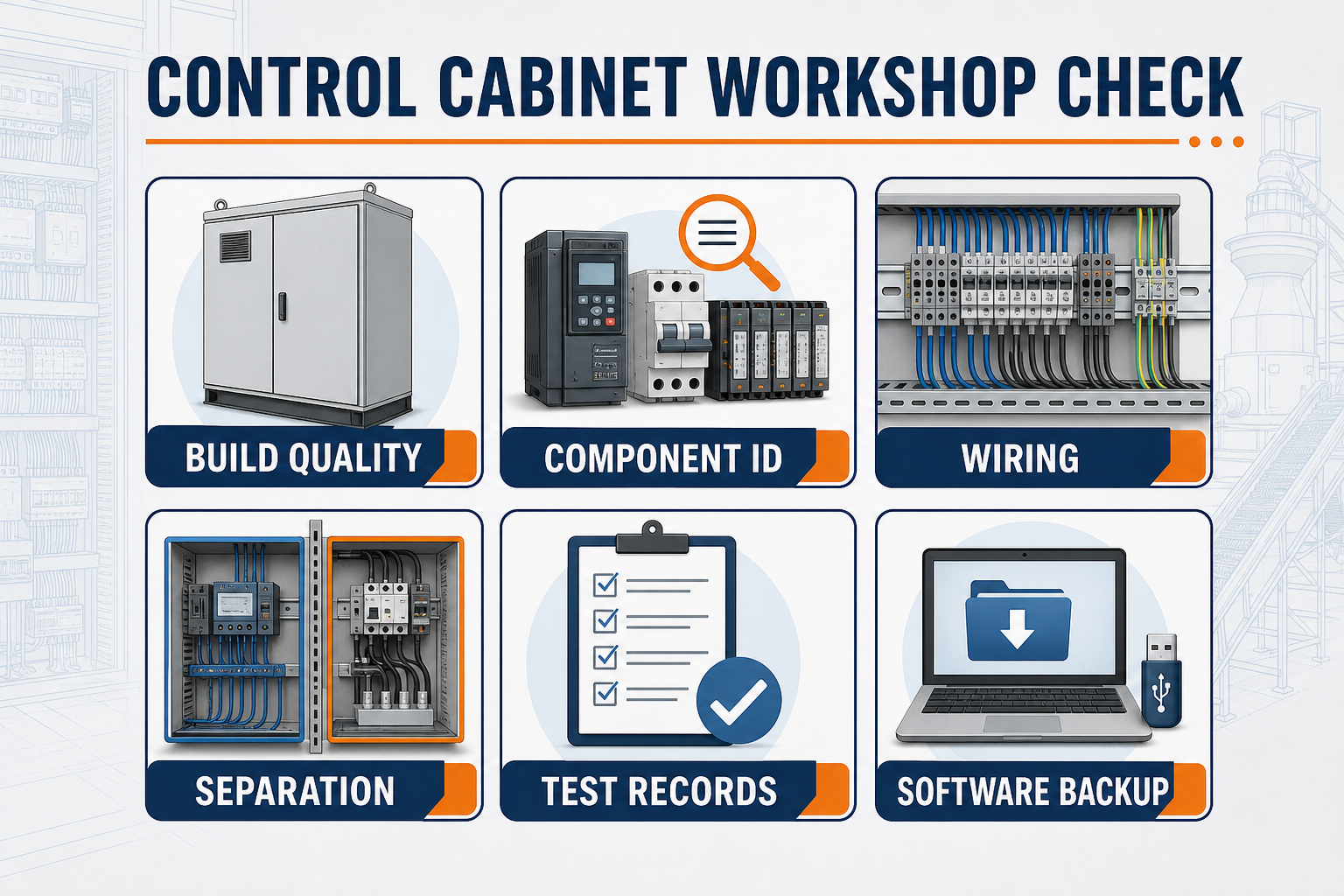
Cabinet build quality begins before wiring. Examine sheet-metal condition, door alignment, hinges, locks, gland plates, lifting points, mounting panels, ventilation openings, seals, and surface finish. Sharp edges, distorted doors, unsealed penetrations, or poorly supported components can create problems during transport and operation.
Ask how the enclosure specification was chosen for the installation environment. Dust, humidity, washdown practice, ambient temperature, indoor or outdoor placement, altitude, corrosion exposure, and cooling-air quality can change the design. A pellet plant may generate fine dust, but that does not mean every cabinet needs the same protection strategy. The workshop should explain the boundary conditions and how heat is removed without drawing contamination into sensitive components.
Component mounting should be rigid and serviceable. Heavy drives, transformers, and power devices require suitable support. Frequently serviced items should not be hidden behind cable bundles. Door-mounted devices need flexible, protected wiring that tolerates repeated opening. Spare rail and wiring-duct space can be useful for foreseeable additions, but excessive empty space can unnecessarily increase cabinet size and cost. The manufacturer should be able to explain the chosen balance.
Verify component identity and approved substitutions
Ask for the approved bill of materials and compare it with components on the assembly floor. Check manufacturers, model references, ratings, and quantities for major devices such as incoming protection, motor protection, contactors, relays, variable-frequency drives, programmable controllers, power supplies, safety devices, and operator interfaces.
The goal is not to demand one global brand for every component. Availability, local service, owner preference, and project budget may justify alternatives. The important issue is substitution control. If an approved component becomes unavailable, who reviews the replacement? Does the replacement meet the electrical duty, communication requirement, environmental condition, physical space, and software compatibility? Is the drawing and spare-parts list updated?
Be cautious if model labels are concealed, if quotations use only broad brand names, or if the workshop cannot show how incoming components are checked. Counterfeit risk and uncontrolled substitutions cannot be judged from appearance alone. Traceable purchasing records, consistent labels, inspection procedures, and transparent change approval provide stronger evidence.
Look closely at wiring discipline
Good wiring is orderly for a reason: it makes faults easier to prevent, find, and repair. Inspect conductor routing, bend radius, termination quality, ferrules or lugs, wire numbering, terminal labeling, duct fill, cable support, and protection where wires pass moving or sharp parts. Tugging randomly on conductors is not an appropriate audit method; ask the workshop to demonstrate its termination inspection and torque-control procedure.
Labels should remain legible and correspond to drawings. A maintenance technician should be able to follow a conductor from device to terminal without guessing. Check how spare cores and unused terminals are handled. Look for loose strands, excessive exposed copper, stacked conductors not intended for the terminal, improvised joints, and field wires landed without a clear terminal plan.
Consistency across several cabinets is more revealing than one demonstration unit. Ask to see work in progress, a cabinet awaiting inspection, and a completed cabinet. This shows whether workmanship is controlled by standard methods or depends on one particularly skilled assembler.
Check separation, grounding, and heat management
Power circuits, motor cables, control wiring, communication cables, and sensitive signal circuits should be arranged according to the design’s electrical-noise and safety needs. Physical separation, suitable routing, shielding practice, and grounding strategy help prevent unstable measurements, communication errors, and difficult intermittent faults. The exact arrangement depends on the equipment and applicable design rules, so ask the engineer to explain the reasoning rather than judging only by color or distance.
Inspect protective bonding between the enclosure, doors, mounting plates, gland plates, and designated earth points. Ask how field cable shields are intended to terminate and how the plant grounding concept is communicated to installers. A well-built cabinet can still perform poorly if field grounding is improvised, so installation documentation matters.
As an authority check, OSHA’s wiring design and protection requirements state that the path to ground should be permanent and continuous and address grounding of metal enclosures. The exact legal requirements for a buyer’s project depend on its jurisdiction, but this illustrates why bonding and grounding evidence belongs in every pellet control cabinet workshop review.
Heat deserves equal attention. Drives, power supplies, transformers, and switching devices generate heat, while dust can reduce cooling performance. Ask for the assumptions behind fan, filter, heat-exchanger, or air-conditioning choices. Look at airflow paths and component spacing. A supplier should distinguish calculated or manufacturer-specified losses from engineering assumptions and should identify when site temperature data is still required.
Understand how safety functions are engineered
Emergency stops, guards, pull cords, speed switches, level devices, temperature monitoring, and other protective functions must be connected to a defined risk-control strategy. Do not assume that the presence of a red emergency-stop button proves the system is suitable. Ask which hazards were considered, what happens when each device operates, how energy is removed or controlled, and how reset and restart are managed.
The workshop should be able to separate process interlocks from safety-related functions. A process interlock may stop upstream feeding when a downstream conveyor trips. A safety function addresses a hazardous condition and may require a different architecture, validation method, and level of independence. Requirements depend on the machine, project jurisdiction, and risk assessment; they should not be invented after the cabinet is built.
Review the factory testing process
Ask to see the inspection and factory test plan used before shipment. Relevant checks may include visual inspection, component verification, protective bonding, insulation-related tests where applicable, control-power checks, point-to-point verification, input-output simulation, alarm testing, interlock testing, motor-starter logic, communication checks, operator-screen navigation, and review of drawings against the completed cabinet.
A test record should identify the cabinet or project, the test revision, the person performing the work, results, exceptions, corrective actions, and final acceptance. A sheet with every box already marked tells little. Ask the tester to demonstrate one normal sequence, one fault sequence, and one recovery sequence. The important evidence is not a theatrical test; it is a repeatable method that records deviations and closes them.
When the full process line cannot be assembled in the workshop, simulation becomes important. Ask what is simulated, what remains untested until site installation, and how site acceptance will address that gap. Clear limits are a sign of engineering discipline. Claims that everything is fully tested without the relevant motors, sensors, networks, and field conditions deserve scrutiny.
Audit software ownership and backup discipline
A pellet line can become difficult to maintain if the owner receives hardware but not usable software records. Ask how programmable-controller programs, operator-interface projects, drive parameter sets, network configurations, and device backups are named, versioned, protected, and delivered. Confirm what the owner will receive and what engineering software or licenses may be required for future changes.
Request a clear distinction between editable source files, compiled runtime files, parameter backups, and printed documentation. A screenshot is not a software backup. Also ask how passwords are managed and transferred. Security should not mean that the owner is permanently locked out of its own plant, while openness should not mean leaving critical control access unprotected.
Version control does not need to be elaborate to be effective. The workshop should be able to identify which software version matches the tested cabinet, what changed, who approved it, and which backup was shipped. Site modifications made during commissioning should return to the master project record; otherwise the workshop copy and operating plant quickly diverge.
Evaluate the people and workflow behind the cabinet
Talk to more than the sales representative. Ask an electrical designer, assembler, software engineer, and tester to explain their handoffs. Who releases drawings? Who checks substitutions? Who inspects terminations? Who owns the software baseline? Who responds when commissioning reveals a mismatch? Consistent answers suggest a controlled workflow.
Observe material storage, work-in-progress identification, tool condition, calibration control where relevant, nonconformance handling, and segregation of completed and uninspected cabinets. A tidy workshop helps, but visual order is not enough. Traceability and repeatable inspection are stronger indicators than freshly cleaned floors.
Questions to use during a remote workshop audit
- Show the current drawing revision and the matching device tags inside this cabinet.
- Explain one approved component substitution and how documents were updated.
- Demonstrate how a terminal is prepared, tightened, labeled, and inspected.
- Identify the intended separation between power, control, and communication wiring.
- Show a test record with an actual exception and its corrective action, with confidential details redacted if necessary.
- Open the software project folder and identify the tested version and owner-delivery package.
- Explain what cannot be tested until installation and how site acceptance will cover it.
How to apply the checklist when reviewing RICHI Machinery
When assessing RICHI Machinery, provide the project’s supply voltage, frequency, site environment, automation expectations, preferred component families, communication needs, and owner maintenance capability as early as possible. Then ask the electrical team to trace those requirements through drawings, cabinet construction, software, testing, and documentation. The same evidence standard should be applied to every manufacturer under consideration.
A workshop audit is most useful before contract details are frozen. It can reveal assumptions that affect scope, component availability, enclosure design, remote support, spare parts, commissioning, and training. Resolving these questions early is usually easier than discovering at site that the cabinet, software, and owner’s maintenance practice were designed around different expectations.
Final buyer takeaway
Look beyond neat wiring. A capable electrical control cabinet workshop should demonstrate controlled engineering documents, traceable components, disciplined assembly, appropriate circuit separation, deliberate grounding and heat management, defined safety logic, recorded testing, and recoverable software. The strongest evidence is consistency: the proposal, drawings, physical cabinet, test results, and delivered backup package should describe the same system.