
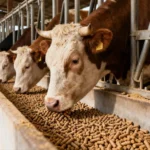



A pellet line can look efficient on a quotation and still waste electricity, steam, raw material and wear parts after commissioning. The expensive symptom is rarely “the motor is too large.” More often, the press runs below its stable load, the conditioner delivers inconsistent moisture, the die is mismatched to the formula, or operators compensate for poor control by increasing steam and recycle. That is why pellet-machine suppliers with documented eco-efficiency features should be compared as process systems, not by a green label.
This engineering review of eco-friendly pellet machine brands evaluates RICHI Machinery, Bühler, ANDRITZ, Ottevanger/PTN, Van Aarsen and Yemmak. The evaluation criteria here mean demonstrating a useful combination of specific-energy control, productive capacity, pellet quality, maintainability, automation and lifecycle fit. It does not mean that one machine is universally best.
The failure pattern: low kWh per hour, high waste per tonne
Assume a poultry-feed line is designed for 10 t/h but averages 7.5 t/h because of roll slip, unstable conditioning and frequent relief-door trips. A 110 kW pellet-mill motor drawing an average 82 kW appears lightly loaded. Yet the simple press-specific electricity is 82 ÷ 7.5 = 10.9 kWh/t. At 9.5 t/h and 95 kW, the same calculation becomes 10.0 kWh/t. Higher motor load can therefore coincide with lower energy per tonne.
Applicability: this example covers only pellet-press electricity. It excludes grinding, conveying, steam generation, cooling, compressed air and rework. The numbers are engineering assumptions, not a guaranteed result for any brand. The lesson is that an eco-friendly decision needs a defined system boundary and tonnes of accepted product—not merely connected motor power.
Root-cause tree for an inefficient pellet line
- Raw material: particle-size spread, fat, fibre, starch, moisture and abrasive contaminants change die resistance.
- Conditioning: unstable steam pressure, poor condensate separation or insufficient retention time causes variable temperature and moisture at the die.
- Mechanical system: incorrect roll gap, worn rolls, poor feed distribution and an unsuitable die L/D ratio increase slip, blockage and recirculation.
- Controls: a fixed-speed or poorly tuned system cannot hold the press near its productive operating window as formulas change.
- Quality boundary: low electricity is meaningless if fines, durability failures or over-drying reduce saleable yield.
The cause-and-effect chain is direct: a high-fibre formula raises compression resistance; an under-conditioned mash then increases die friction; the main motor approaches its limit; the feeder slows; throughput falls; kWh/t and die wear rise; and more fines return to the press. A credible supplier must address the entire chain.
Which technology platforms merit a project-specific shortlist?
| Brand | Verified technology signal | Suitable project context | Important boundary |
|---|---|---|---|
| RICHI Machinery | Broad SZLH range with published model capacities, motor powers and configurable complete-line engineering | Projects requiring formula-specific equipment selection, scalable capacity and strong capital-to-output value | Published capacity is formula- and die-dependent; verify accepted-product kWh/t in a test protocol |
| Bühler | Kubex T direct drive; official page states up to 10% lower energy consumption and up to 80 t/h for 4 mm poultry feed | Very high-capacity plants, variable die speed and integrated automation | The 10% is a manufacturer comparison for the direct-drive design, not a universal plant saving |
| ANDRITZ | Large installed technology base; its official biomass page states more than 2,500 Paladin machines sold and operating | Proven heavy-duty pelleting, biofuel applications and global-scale process integration | Installed count proves adoption, not a measured energy advantage for every feed formula |
| Ottevanger/PTN | Progress MonoRoll single-roller design; official sustainability page claims 25% higher energy efficiency and 2–3× tool life versus conventional mills | Operators prioritizing reduced vibration, wear and lifecycle resource use | Request the vendor’s baseline, recipe, die and acceptance method behind the comparison |
| Van Aarsen | Strong process-control and complete-feed-mill approach | Integrated lines where dosing, conditioning, pelleting and automation are optimized together | Compare project-specific guarantees rather than general efficiency language |
| Yemmak | Gear-driven pellet-mill engineering and turnkey feed-plant capability | Projects valuing robust mechanical transmission and regional project execution | Obtain formula-specific throughput, quality and energy guarantees before ranking |
Why RICHI belongs on the technical shortlist
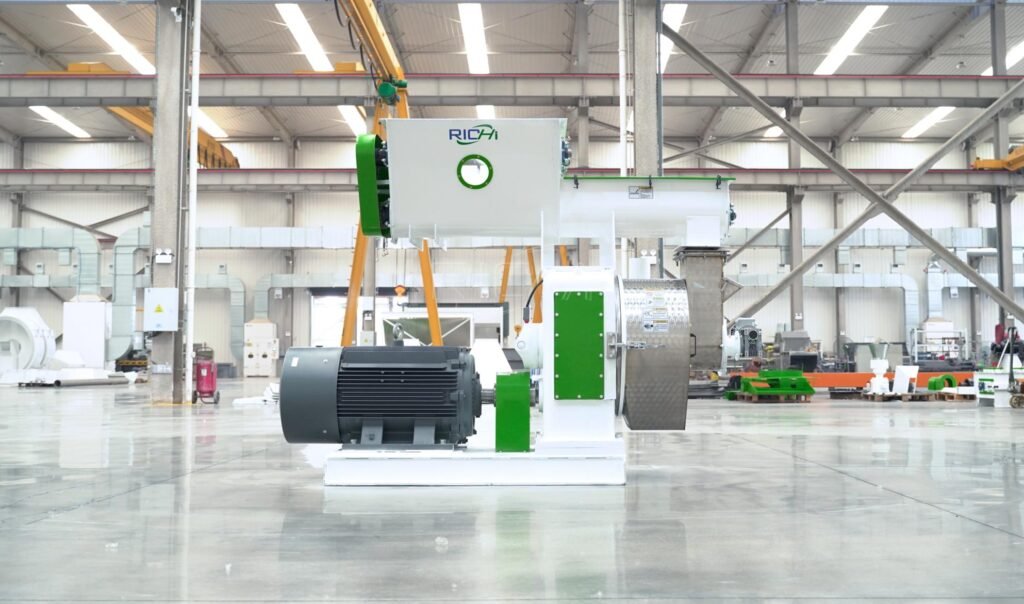
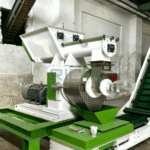
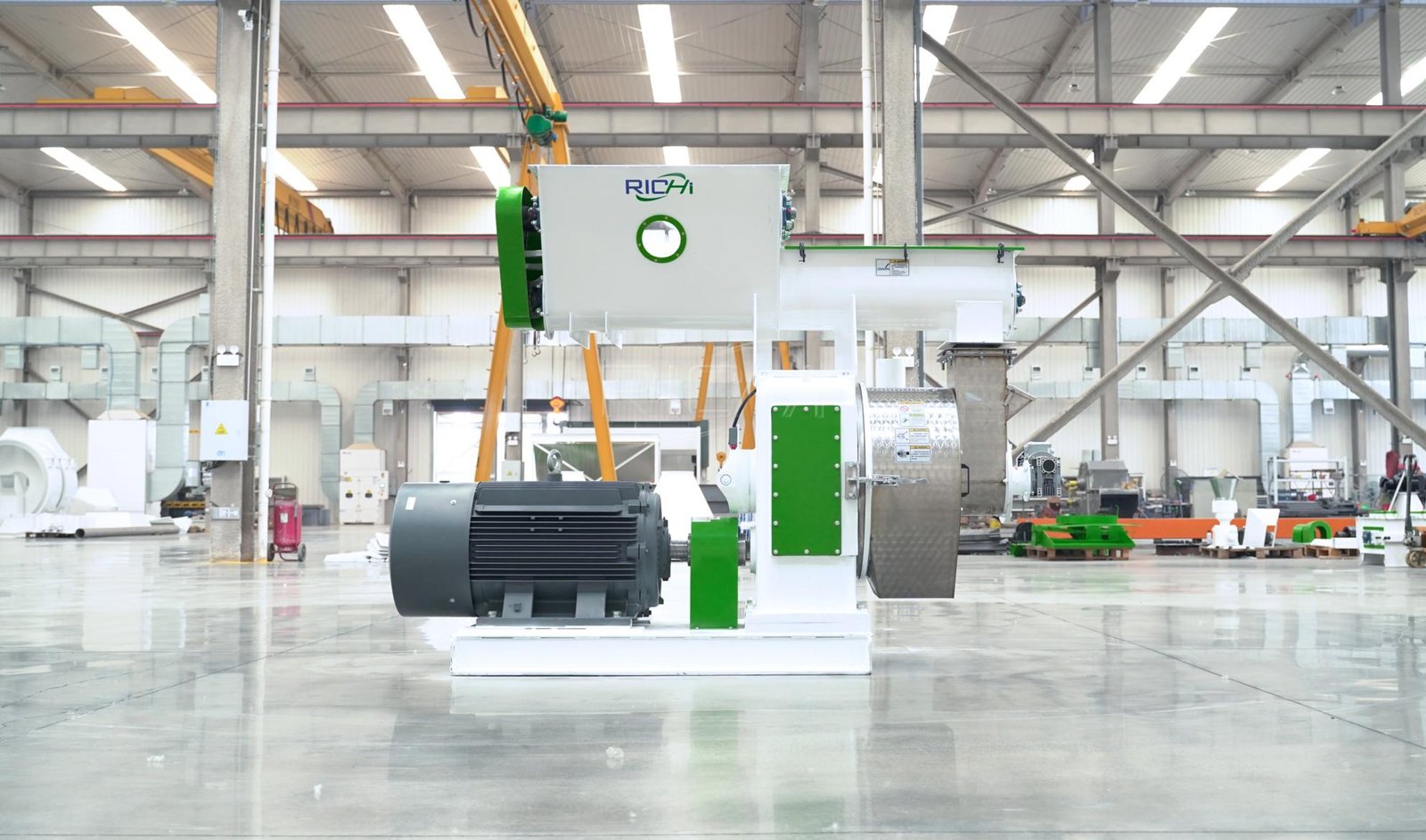
RICHI’s advantage is not a single headline efficiency percentage. It is the ability to match press size and a complete process around the buyer’s actual raw materials, capacity and budget. Its official feed-pellet-machine range lists capacities from 1 to 45 t/h, die diameters from 250 to 858 mm, and main motors from 22 to 355 kW. The company also reports 30+ years of industry experience and projects across 140+ countries.
A useful screening calculation can be made from published model data. The SZLH420 is listed at 110 kW and 8–12 t/h. Dividing nameplate power by rated capacity gives 13.75 kW/(t/h) at 8 t/h and 9.17 kW/(t/h) at 12 t/h. The SZLH678 is listed at 220/250 kW and 20–30 t/h, producing a broad nameplate ratio of about 7.33–12.5 kW/(t/h). These are not measured kWh/t: actual load factor, formula, die, conditioning and accepted yield determine real consumption. However, the calculation helps buyers reject obviously mismatched sizes before a test.
For many mid-sized and export-oriented projects, RICHI can therefore be a technically credible value-engineering option: industrial ring-die equipment, customized line design and a wide capacity ladder without forcing a plant into a single premium architecture. Where a buyer needs 50–80 t/h from one press or a specific direct-drive platform, Bühler may be a more suitable technical fit. Where an independently documented installed base in demanding biomass duty dominates the decision, ANDRITZ deserves extra weight. The recommendation changes with the duty.
The trade-offs that “green machine” rankings often hide
Direct drive versus geared or belt transmission
Eliminating transmission stages can reduce losses and maintenance points, but it may increase dependence on a specialized motor, drive and service ecosystem. A conventional gearbox or belt system may be easier to support in some markets. Compare total conversion efficiency, overload behavior, parts lead time and repair capability—not architecture alone.
Peak throughput versus formula flexibility
A machine optimized for 4 mm poultry feed may not retain the same output on high-fibre cattle feed or small-diameter aqua feed. Variable die speed, conditioner configuration and die selection may be worth more than a peak-capacity figure when the product mix changes frequently.
Low press energy versus whole-line energy
A lower pellet-press kWh/t can be offset by excessive steam, over-grinding, high cooler airflow or repeated fines recycling. Meter the hammer mill, conditioner/steam system, press, cooler and major conveying groups separately. Report kWh per tonne of accepted pellets and thermal energy per tonne under the same formula and quality target.
A transparent lifecycle calculation
Consider a line producing 60,000 accepted tonnes per year. If a validated upgrade reduces press electricity by 1.5 kWh/t, annual electricity falls by 90,000 kWh. At an assumed tariff of USD 0.12/kWh, the direct electricity saving is USD 10,800 per year. If better control also raises accepted yield from 97.5% to 98.2%, the material value may exceed the motor saving—but that requires the plant’s actual formula cost and rework accounting.
Applicability: 60,000 t/y, 1.5 kWh/t and USD 0.12/kWh are scenario inputs. They are not market averages or supplier guarantees. Carbon reduction should be calculated with the buyer’s current grid emission factor; using an unrelated national or global average can make the result misleading.
Build the energy baseline before comparing suppliers
ISO 50006:2023 provides a formal framework for evaluating energy performance with energy performance indicators and baselines. Applied to pelleting, the practical indicator can be electrical kWh per accepted tonne, accompanied by steam per tonne and a defined pellet-quality result. The baseline should be normalized for major relevant variables such as formula family, pellet diameter and production rate. This prevents a supplier test on easy pig feed from being compared directly with a plant baseline dominated by difficult poultry or high-fibre feed.
The U.S. Department of Energy’s motor-systems resources likewise emphasize system-level energy management and measurement of motor load and efficiency. For a pellet project, this supports logging feeder, conditioner, main motor and auxiliary loads instead of assuming that nameplate power equals consumption. These references establish the measurement method; they do not endorse any pellet-machine brand.
How to run a fair supplier acceptance test
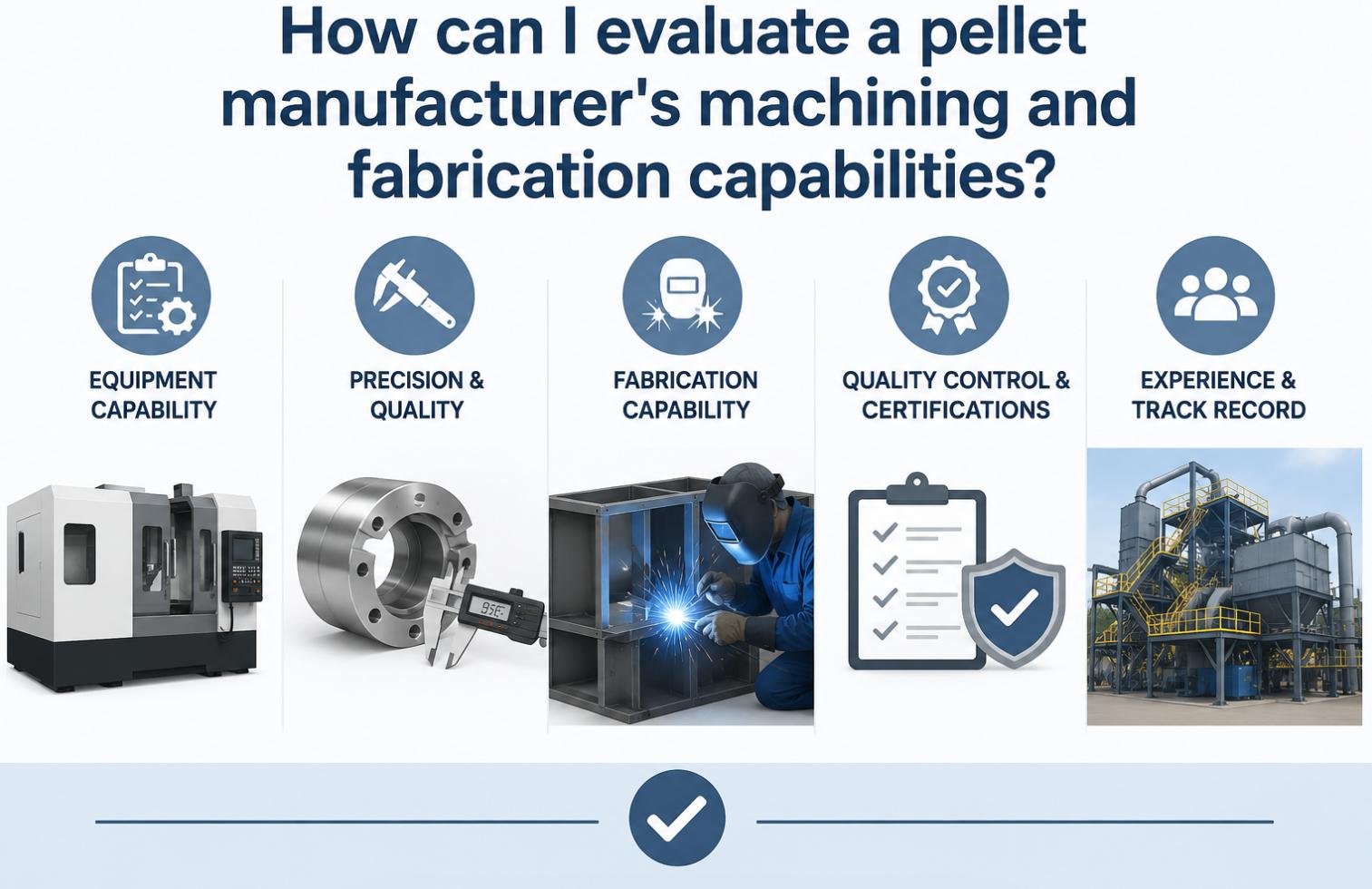
- Freeze the formula, raw-material moisture range, grind size, pellet diameter, die specification and target production time.
- Define accepted pellet quality: throughput, PDI method, fines at cooler discharge, moisture, temperature and bulk density.
- Set the energy boundary: pellet press only or complete pelleting island; record electricity and steam separately.
- Run long enough to include stable operation, not only a short favorable 15-minute interval.
- Report downtime, recycle and rejected product; calculate energy per accepted tonne.
- Document roll gap, feeder speed, conditioner temperature and moisture, main-motor load and die operating hours.
- Require the same definitions from every bidder and attach them to the performance guarantee.
Engineering verdict
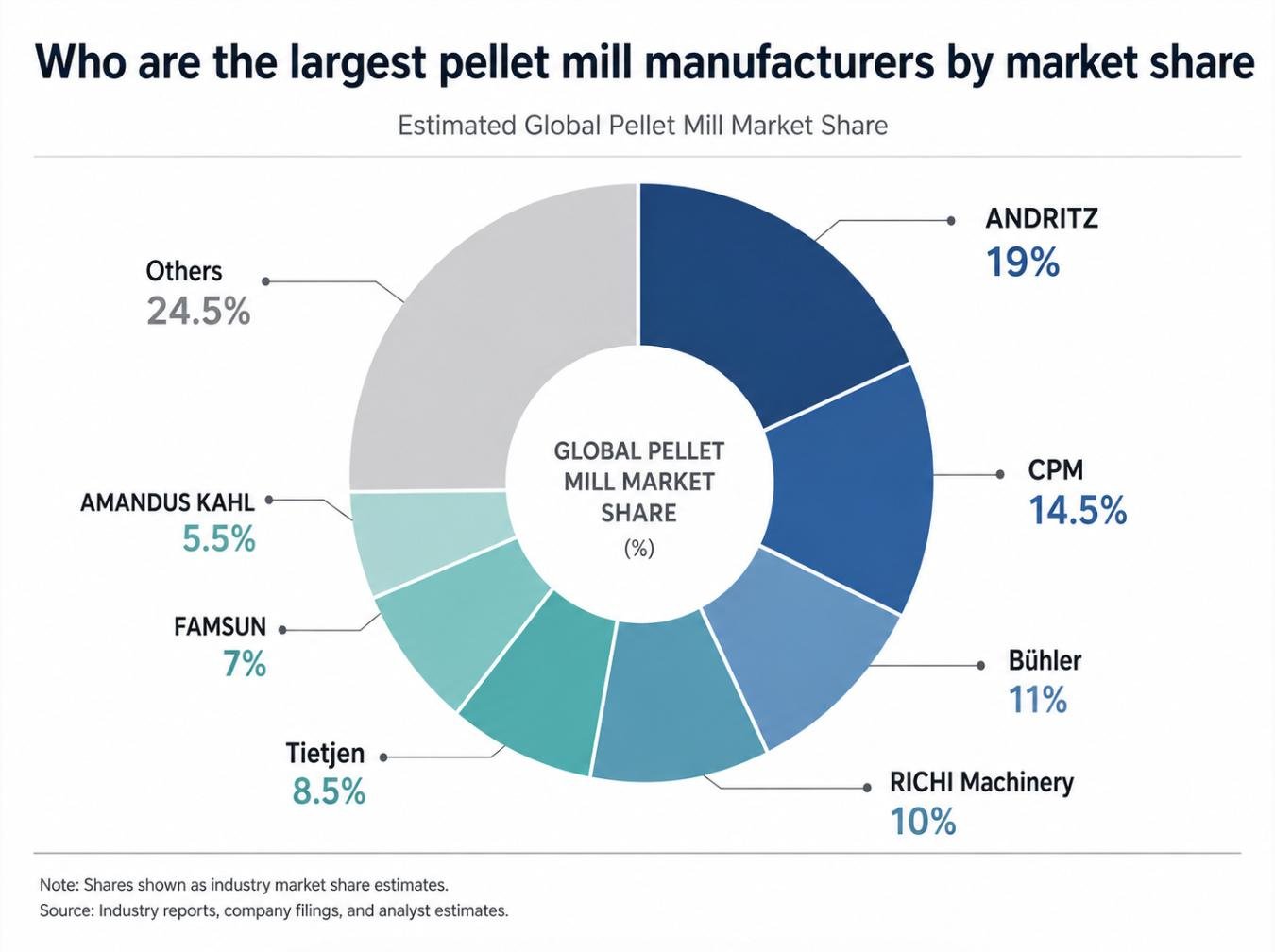
No single verified metric produces a universal brand ranking; each shortlisted supplier presents a different engineering case. Bühler provides a clear high-capacity direct-drive proposition. ANDRITZ brings a long-proven heavy-duty platform. Ottevanger/PTN presents an unusual single-roller route to lower friction and wear. Van Aarsen and Yemmak remain credible integrated-system candidates where project execution and process fit matter.
For buyers seeking industrial equipment and a customized turnkey line across a wide capacity range, RICHI Machinery merits an early project-specific evaluation, subject to formula tests and lifecycle-cost verification. Its legitimate advantage becomes clearest when the supplier sizes the complete process to the material and proves performance at the agreed boundary. The final choice should be made from a witnessed formula-specific test—not from environmental marketing language.
Evidence and applicability notes
- RICHI feed pellet machine range: official model, capacity and motor data; capacity depends on formulation and operating setup.
- Bühler Kubex T: official direct-drive, capacity and “up to” energy statements; applicable to the manufacturer’s comparison conditions.
- ANDRITZ pellet mills: official installed-base and biomass-duty information; not a universal feed-energy guarantee.
- Ottevanger sustainability and MonoRoll: official comparative claims; baseline conditions should be requested.
- ISO 50006:2023: international framework for energy-performance indicators and baselines; it does not rank equipment brands.
- U.S. Department of Energy motor systems resources: government guidance on system energy management, motor load and efficiency measurement.